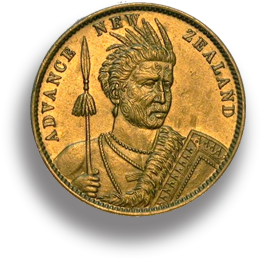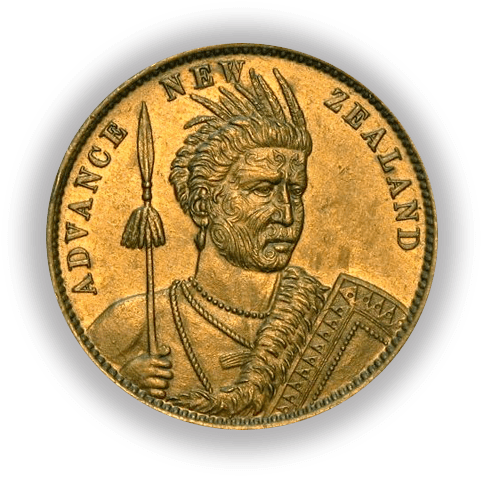
King's Silver Jubilee Portrait by Percy Metcalfe 1935.


NZNDA member








New Zealand's first distinct official silver coinage was issued during the reign of King George V.
Percy Metcalfe, British engraver at the Royal Mint in London created the crowned bust image King George V in 1933.
His obverse design featured the left-facing King with the legend "GEORGE V KING EMPEROR".
The reverse designs such as the Maori warrior shilling and the Hui bird sixpence were designed by the artist George Kruger Gray. Metcalfe's profile portrait of King George V was widely used across the British Empire, appearing on the coins of Australia, Canada, Fiji, Mauritius, and Southern Rhodesia during the 1930's.
Two of his most iconic works were the New Zealand Waitangi crown and the Canadian Silver Jubilee dollar both issued in 1935. The Waitangi crown commemorates the signing of the 1840 Treaty of Waitangi, and features Lieutenant-Governor William Hobson shaking hands with Ngāpuhi chief Tāmati Wāka Nene on the reverse. The coin was issued as a special collector piece rather than for general circulation. Regarded as the pinnacle of New Zealand numismatics due to its rarity and high market value.
Canada's first Silver Dollar 1935.
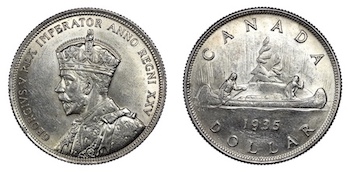
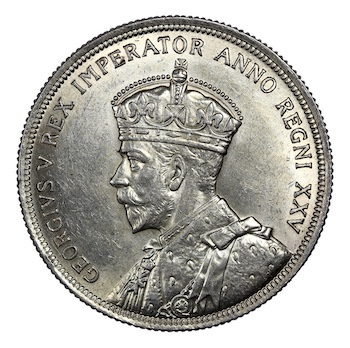
The obverse portrait of King George V by Percy Metcalfe featured the King wearing the Imperial State Crown and coronation robes. The Jubilee Legend reads: "George V, King and Emperor, 25th Year of Reign". Metcalfe's portrait was only used on this single Canadian coin, the next Canadian dollar to be issued in 1936 reverted to the standard, crownless portrait by Sir Edgar Bertram MacKennal. The reverse of this iconic Canadian dollar featured the famous "Voyageur." It depicts a fur trader and an indigenous man paddling a birch-bark canoe past a wind-swept island, with stylised Northern Lights (aurora borealis) in the sky. One of the cargo bundles is marked "H. B". for the Hudson's Bay Company.
Grading criteria for the 1935 Canadian Voyageur Doller.
Focus heavily on specific high points that show wear first, alongside the coin's overall eye appeal and luster.
Obverse (King George V Portrait): Check for wear on the shoulder of the coronation robes, the fur trim on the cloak, the band of the Imperial State Crown, and the high points of the King's cheek and eyebrow.
Reverse: (Voyageur Canoe): Look closely at the paddler's shoulder and thigh, the lines defining the canoe's birch-bark texture, and the crispness of the individual trees on the island background.
Grades Very Fine: The coin shows moderate, even wear. The Kings's crown and robes are clear but flat on top. On the reverse, the lines on the canoe are visible but the paddler's facial features and shoulder muscle are worn smooth.
Grades Extremely Fine: Wear is light and only visible on the highest design elements. The fur on the King's robes shows good separation. Most of the original mint luster has disappeared, though some may remain in the protected lettering.
Grades About Uncirculated: The coin looks almost mint, but has traces of wear or friction on the absolute highest points. (the cheekbone on the obverse; the paddler's thigh on the reverse). A significant amount of original mint luster is present.
Grades Uncirculated: The coin has no wear, grading in this tier depends on the absence of bag marks, scuffs, or scratches, luster strength and strike.
Official souvenir medal. This exposition celebrated the opening of the Panama Canal on August 15th 1914, with the passage of the S.S. Ancon. It was meant to tout San Diego as the first port of call to the United States for ships traveling north after passing through the canal into the Pacific Ocean. Official Souvenir […]
Struck at mobile military mints. Roman Imperatorial Coinage 71-27 B.C. Civil War period 49 to 45 B.C. The silver denarius featured below was struck in 49 B.C. Featuring the image of an elephant serves as a fascinating artefact from one of the most pivotal eras in Roman history. This coin is often associated with Julius […]
This period in Greece was a time of significant political, cultural, and economic change. It witnessed the rise and fall of powerful city-states, the expansion of Greek influence across the Mediterranean, and Rome's eventual conquest.One of the most notable developments during this period was the standardization of coinage. This facilitated trade and commerce across the […]